Veterinary Advisor: Dogs Cats
- 4.4
- Rating
- 10.00K
- Installs
- Free
- Price

 Analysis by App-foxy
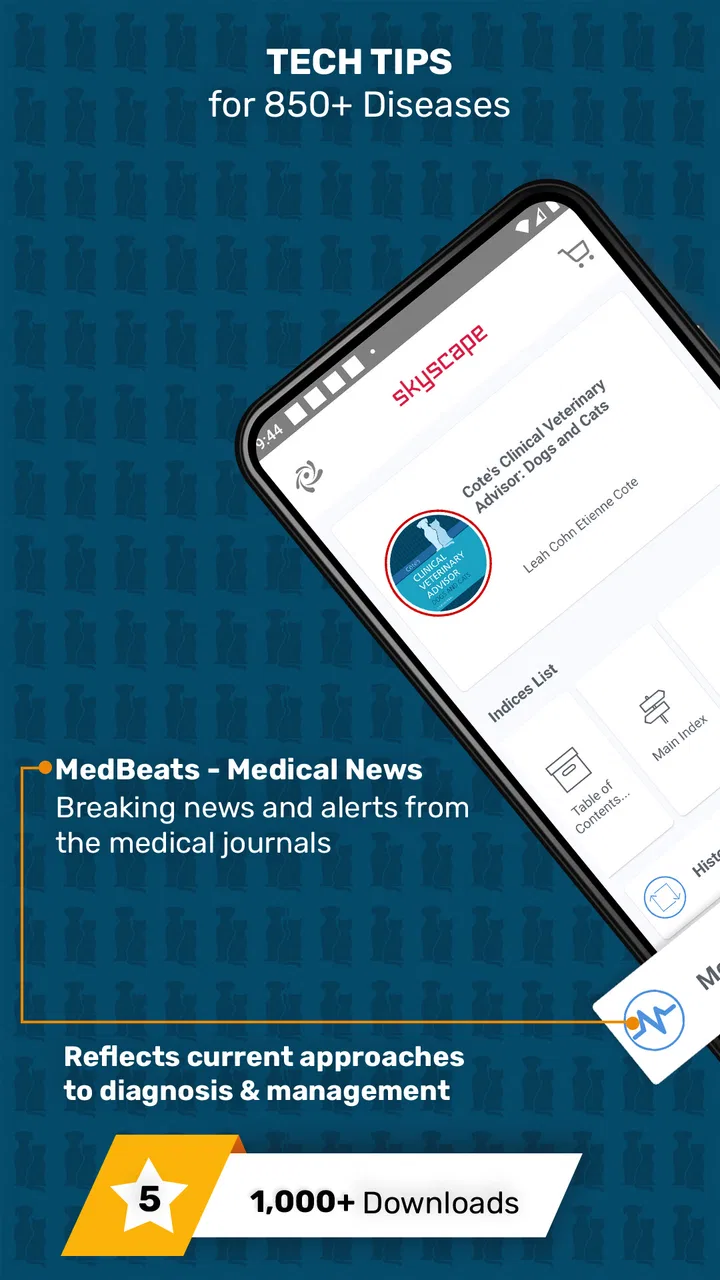
When I need a quick clinical reference for a small-animal question, I want something more useful than a broad web search and less cumbersome than carrying a large reference book. Veterinary Advisor: Dogs Cats is built for that middle ground. It is a medical app from Skyscape Medpresso Inc., aimed at veterinary professionals who work with dogs and cats and need focused information close at hand.
My main impression is that its value comes from turning a moment of uncertainty into a structured reference check. It is not a substitute for examination, laboratory work, imaging, professional judgment, or emergency services. Instead, it works best as a companion during preparation, consultation, and follow-up. The app’s store summary calls it an indispensable resource for the busy small animal practitioner, and I think that description makes sense when “indispensable” is understood as a practical reference role rather than an all-in-one clinical system.
The app is free to install and carries an Everyone content rating, which makes trying it straightforward. Its average rating is 4.4 from 57 ratings, and it has passed 10K+ installs. Those figures suggest a modest but established audience rather than a mass-market pet-care app. The current version is 3.13.1, with Android support beginning at 7.0.
You May Also Like

 Blood Strike: 2.5 Anniversary
Blood Strike’s Loadouts Turn Every Drop Into a Tactical Gamble
A close look at Blood Strike’s custom loadouts: how fast access to signature weapons reshapes its battle royale rhythm, rewards preparation, and narrows the gap between fights.

 Pandora - Music & Podcasts
Pandora’s Music Is Easy to Start, but Harder to Recover
Pandora’s strength is its low-effort path from a seed to a station. Its weak spot is how much confidence it asks you to place in connection, setup, and quiet recovery.

 8 Ball Pool
 Is Built on Rivalries, Rematches, and Routine
A close look at the rivalries, rematches, shared routines, and unanswered safety questions that turn a quick pool match into a persistent mobile community.

 Samsung Music
’s Quiet Strength Is Playing What You Already Own
Its reach comes less from spectacle than from dependable access to a personal library. That simplicity is both the app’s strongest retention engine and its ceiling.

 AccuWeather: Weather Radar
AccuWeather Review: A Quick, Clear Forecast for Everyday Decisions
For everyday plans, the best forecast is the one you can understand quickly. AccuWeather makes rain timing, radar, and local conditions easy to act on, with a few trade-offs.

 Hill Climb Racing
Why Hill Climb Racing Still Turns Crashes Into One More Run
A tiny car, a bumpy hill and one more upgrade: Hill Climb Racing keeps resurfacing because its simple chaos makes every near-miss feel personal.
More From Our News Desk
View All News


Why its focused reference capability matters
The most important capability here is not simply having veterinary information on a phone. It is having a reference designed around the two species that small-animal practitioners see most often: dogs and cats. That narrower focus changes how useful a reference feels during a busy appointment. Instead of starting with general animal-health material, I can approach a question with the relevant patient type already in mind.
That matters because a symptom rarely has the same meaning across species. A clinical sign, medication concern, or disease pattern may need to be interpreted differently in a dog than in a cat. A reference that keeps the species context visible can reduce the risk of treating a general search result as though it applies equally to both. I still verify every important decision against the patient and the wider clinical picture, but the app gives me a more appropriate starting point than a generic search engine.
I also like the way a focused reference changes the order of my thinking. Rather than searching the internet, opening several pages, and deciding which source deserves trust, I can begin with a veterinary-specific resource and then identify what needs further confirmation. That is especially useful when I am preparing to explain a condition to an owner or reviewing a topic before seeing a patient.
The real benefit is reduced search friction, not replacement of clinical judgment. That distinction is important. Someone expecting automatic diagnosis, personalized treatment plans, or a digital consultation service will be disappointed. The app is better understood as a professional reference layer that supports decisions made by a qualified practitioner.
Using it before, during, and after a consultation
In practice, I would use Veterinary Advisor: Dogs Cats in three different moments. Before an appointment, it can help me refresh a disease topic or organize the questions I want to ask. During a consultation, it can support a concise explanation when an owner asks what a condition generally involves. Afterward, it can help me revisit the subject while planning what information to reinforce at follow-up.
That workflow is more realistic than treating the app as something that stays open continuously throughout every examination. A reference app is most useful when it answers a defined question. If I already know what I need to check, the phone becomes a quick tool. If I open it without a clear purpose and browse broadly, the experience is less efficient and may encourage me to collect information without deciding how it applies.
A useful habit is to write down the clinical question before opening the app. For example, I might ask myself whether I am checking a differential, refreshing a disease overview, or looking for language that will make an owner explanation clearer. That small step prevents the reference from becoming a distraction and makes it easier to judge whether the information actually helped.
Another practical tip is to treat the app as a preparation aid rather than the final authority in a complicated case. If the patient has several conditions, unusual findings, or a treatment history that changes the risk calculation, a single reference entry will not capture the complete situation. In those cases, the app can help define the topic, but a more detailed source or consultation with a specialist may be the better next step.
A realistic small-animal practice scenario
Imagine a busy appointment involving a dog whose owner has noticed a worrying change and wants a clear explanation. The practitioner may already have a working plan, but the owner’s questions can move the conversation into areas that were not part of the original examination. This is where a focused veterinary reference can be useful: not to announce a diagnosis, but to refresh the practitioner’s understanding and support a calm, accurate discussion.
I would use the app before speaking in detail, identify the relevant topic, and then return to the patient rather than reading from the screen throughout the conversation. That approach keeps the consultation personal. It also avoids a common problem with medical apps: allowing the device to become a barrier between practitioner and owner.
The same scenario works for a student or newly qualified professional preparing for a case. The app can serve as a compact review tool when time is limited. The advantage is not that it makes difficult cases easy. The advantage is that it gives the user a focused place to begin, which can make later reading more deliberate.
For an owner at home, however, the situation is different. A pet owner may find the subject matter interesting, but the app is not the right tool for deciding whether a pet needs urgent care or for choosing a medication independently. The Everyone rating describes the app’s broad content classification, not a promise that its material is suitable for unsupervised diagnosis or treatment.
Where it fits beside ordinary alternatives
The usual alternative is a web search. Search engines are faster for discovering general information, but they also mix professional references, commercial pages, forums, and personal anecdotes. That variety can be useful when researching a broad topic, yet it creates extra work when I need a veterinary-specific starting point. Veterinary Advisor: Dogs Cats is more focused, so it is less likely to send me immediately into irrelevant human-health or general pet-care material.
Another alternative is a printed veterinary reference. Books can be comfortable for extended reading and may be easier to annotate or compare across pages. They are also less dependent on a phone screen. The app’s advantage is portability and availability during a mobile workflow. If I am moving between rooms, preparing for a consultation, or carrying minimal equipment, a digital reference is simply easier to keep nearby.
A third alternative is a broader veterinary database or a specialist resource. Those may be preferable when I need highly detailed evidence, advanced drug information, current literature, or a narrow specialty perspective. The focused scope of this app is helpful for everyday small-animal reference work, but focus also means it should not be mistaken for every kind of veterinary library.
The most sensible setup is therefore complementary. I would use the app for an initial clinical refresher and practical orientation, then move to a more specialized source when the case demands greater depth. That is a stronger workflow than asking one app to cover every stage of professional decision-making.
The tradeoff between convenience and depth
The first limitation is the unavoidable tension between quick access and comprehensive detail. A compact mobile reference is valuable because it is approachable under time pressure. Yet the more complex the patient, the less likely a short consultation with one reference will be enough. Users should be comfortable recognizing when the app has answered the immediate question and when it has only opened the door to further research.
The second tradeoff concerns the free download and paid content. The app itself is free, but in-app purchases range from $69.99 to $89.99 per item. That is a significant consideration for casual users and for professionals deciding whether a particular reference fits their budget. I would not install it assuming that every useful part of the experience will remain free. Before relying on it in a practice, I would review what is accessible without purchase and decide whether the available material justifies any additional spending.
This pricing structure may make more sense for a practitioner who uses veterinary references regularly than for a pet owner who has one occasional question. A professional can judge the value based on repeated use, time saved, and how well the content fits daily cases. A casual user may be better served by discussing concerns with a veterinarian and using reputable public educational resources for general background.
There is also a workflow limitation: a phone reference can tempt users to search while they should be observing the patient or listening to the owner. I would keep the lookup brief, make a note of the question, and return attention to the consultation. The app helps most when it supports the appointment rather than competing with it.
Who gets the most value from it
The strongest audience is the busy small-animal practitioner who regularly handles dogs and cats and wants a veterinary-specific reference close at hand. Veterinary students, interns, and newly qualified clinicians may also appreciate it as a revision and preparation aid, especially when they want to turn a broad case into a focused reading task.
It can also help a practitioner prepare owner-friendly explanations. A good consultation is not only about knowing the clinical facts; it is about explaining them without unnecessary alarm or confusing jargon. A focused reference can help me refresh the essential points before I describe them in everyday language. I would still avoid showing an owner a technical entry without context, because the same information can be interpreted very differently outside a professional assessment.
The app is less suitable for someone looking for symptom-checker convenience. It is also not the best choice for a veterinary professional whose main need is a highly specialized research database, a complete prescribing workflow, or a tool built around practice administration. In those situations, a different reference or a dedicated clinical system may offer a better match.
One non-obvious strength is how well it can support question triage. When I encounter an unfamiliar topic, I can use a species-focused reference to decide whether I need a deeper source, a second opinion, or simply a clearer explanation for the owner. That makes the app useful even when it is not the final source I consult. Its role is often to improve the next decision.
Another useful tradeoff is that its narrow dog-and-cat orientation can be an advantage for mixed-practice users only in certain moments. If most of their work involves other species, the app will not address their central needs. But for the portion of a mixed caseload involving dogs and cats, the focused material may still be more efficient than a reference that treats every species equally and therefore gives less immediate context.
What I would check before relying on it
I would begin by confirming that the app’s accessible material matches my professional role and the topics I commonly encounter. Because paid items sit alongside the free installation, that check matters more than the download itself. I would also make sure the device can run the current version, since support starts with Android 7.0 and the app is currently at version 3.13.1.
I would then test it with real questions rather than browsing randomly. A useful trial might include preparing for a dog consultation, reviewing a cat-related topic, and checking whether the structure helps me locate information quickly enough for my workflow. If it consistently reduces the time needed to frame a question, it has practical value. If I still need to search elsewhere for every case, the purchase decision becomes harder to justify.
Finally, I would establish a personal rule: no important diagnosis or treatment decision rests on one app entry alone. That is not a criticism unique to this product; it is a sensible standard for any mobile medical reference. The patient’s history, examination, tests, current therapies, and individual risks must remain central.
Overall, I see Veterinary Advisor: Dogs Cats as a focused companion for veterinary work rather than a complete clinical platform. Its strongest effect is making species-relevant reference material easier to reach when time is short. The free installation makes evaluation accessible, while the paid items mean regular users should consider the cost carefully. With the right expectations, it can fit neatly into preparation, consultation support, and follow-up learning.
I would recommend it to veterinary professionals and students who want a dog-and-cat reference that can sit alongside their existing books and databases. I would not recommend it as a self-diagnosis tool for pet owners or as the only resource for complex cases. For me, the deciding question is simple: does a focused veterinary reference improve the next clinical question I need to answer? For the right user, this app has a good chance of doing exactly that.
FAQs for Veterinary Advisor: Dogs Cats
01What is Veterinary Advisor: Dogs Cats used for?
Veterinary Advisor: Dogs Cats is designed as an educational reference tool for dog and cat owners. It can help you review general information about common symptoms, illnesses, conditions, preventive care, and basic veterinary topics. The app may be useful when preparing questions for a veterinarian, but it should not be treated as a substitute for a professional examination, diagnosis, or treatment plan.
02Can Veterinary Advisor: Dogs Cats diagnose my pet’s illness?
No. The app should not be used to diagnose a dog or cat based only on symptoms or descriptions. Many conditions share similar warning signs, and the seriousness of a problem can vary depending on the animal’s age, breed, medical history, and behavior. Use the information as general guidance, and contact a qualified veterinarian for an accurate diagnosis and appropriate care.
03Is Veterinary Advisor: Dogs Cats suitable for emergencies?
It is not a replacement for emergency veterinary services. If your pet has difficulty breathing, severe bleeding, poisoning, seizures, collapse, serious injury, repeated vomiting, or another rapidly worsening symptom, seek urgent professional help immediately. The app may provide background information, but reading an article should never delay contacting an emergency clinic or veterinarian.
04Does the app cover both dogs and cats?
Yes, Veterinary Advisor: Dogs Cats focuses on health information for both major companion animals. Users can consult topics relevant to dogs as well as cats, although the available material and level of detail may differ between species. Always check that the information applies to your pet, since medications, symptoms, nutritional needs, and safe treatments can vary considerably.
05Should I follow treatment or medication advice found in the app?
You should not give your pet medication, change a prescribed dose, or begin a treatment solely because it is mentioned in the app. Some human medicines and even commonly used pet products can be dangerous when used incorrectly. Treat the content as general educational information, verify concerns with your veterinarian, and follow professional instructions based on your pet’s individual condition.
Pros
- Covers common dog and cat health concerns in one handy reference.
- Useful for preparing questions before visiting a licensed veterinarian.
- Searchable information makes topics easy to find quickly.
- Helpful for new pet owners learning basic care and warning signs.
- Can support routine monitoring of your pet’s health at home.
Cons
- It cannot replace a physical examination or professional veterinary diagnosis.
- Some advice may not apply to pets with unusual breeds or medical histories.
- Emergency symptoms require immediate veterinary care
- not app-based guidance.
- Information may become outdated as veterinary recommendations change.
- Users may find the medical terminology difficult without extra explanation.

Veterinary Advisor: Dogs Cats
Gallery